You'll need
- Reflective objects such as mirrors, TV screen, a metal spoon, kitchen foil or the back of a CD
- Objects to test such as a torch, toys, people
What to do
- Hold an object in front of a mirror and observe the reflection.
- Describe what the reflection looks like.
- Experiment with ways to make the reflection change.
- Identify any lines of symmetry where half of the object is reflected to make it look whole.
- Test other reflective surfaces around your house.
- Compare the reflection on a mirror to other types of reflective surfaces.
Questions to ask
- How many mirrors can you find around the house?
- What important jobs do these mirrors help us do?
- Where else do you see reflections?
- What is similar between these reflective surfaces?
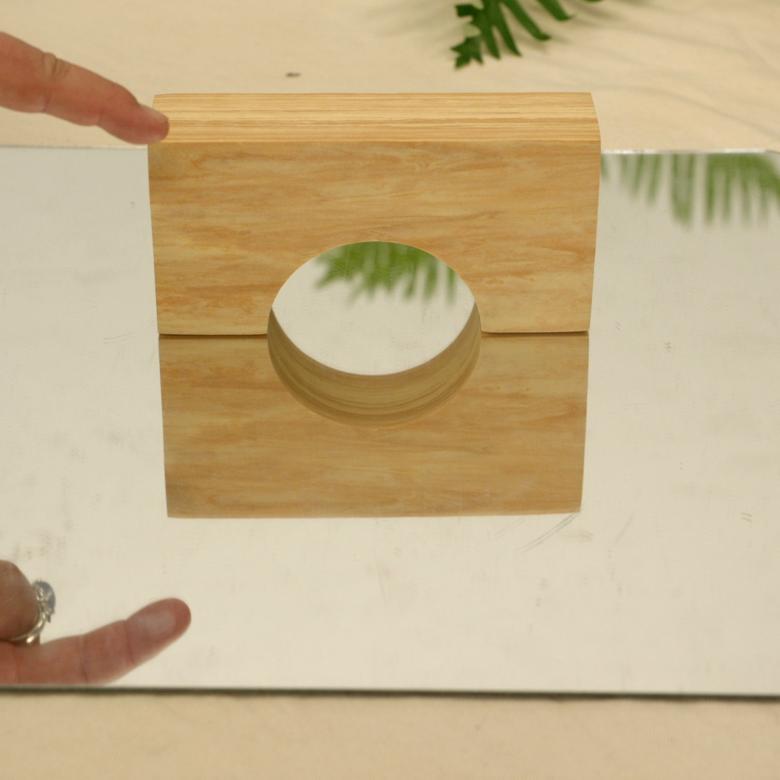
- How can you make half an object look whole using it's reflection?
What's happening
Mirrors and other smooth surfaces reflect light. Light bounces off objects in all directions. If this light then hits a mirror, it bounces off the mirror and reaches our eyes, causing us to see a reflection of the object.
Science Time At Home - Reflections.
[An image appears of a Science Time sign top right, sketches of a gecko, an eye, a grasshopper, a sun, a drum, an ear, leaves, an open mouth, and children around the Questacon logo, and text appears: Science Time, For 3 to 5 year olds and their carers]
[Image changes to show Heading text surrounded by a chalk drawing images of bubbling beakers and a butterfly, flowers and seedlings growing from seeds, and text appears: Reflections]
Children: Reflections.
[Image changes to show BJ talking and waving to the camera, sitting in a chair on the left beside a table with a mirror on the right]
BJ: Hi I'm BJ. Welcome to Science Time, experimenting at home. Do you like experimenting?
[Image continues to show BJ talking to the camera, and placing a hand on her chest]
I do, and at home we can do lots of different experiments.
[Image continues to show BJ talking to the camera]
Today we're going to experiment with reflections. What is a reflection and where can we see a reflection?
[Image continues to show BJ talking to the camera, while pointing at a mirror on the table on the right]
I've got something here that I can see my reflection in. Can you guess what it might be?
[Image continues to show BJ talking to the camera as she is picking up the mirror and holds it up so you can see her reflection, and pointing at the mirror, as the mirror shows it mimicking BJ’s actions]
I'll lift it up and you can see. Oh look, here I've got a mirror and I can see my reflection in the mirror. Can you see me? And whatever I do, my reflection will do.
[Image continues to show BJ talking to the camera and smiling at the mirror, the mirror reflects BJ smiling, and then she points at the mirror]
So if I smile, my reflection smiles.
[Image continues to show BJ talking to the camera and sticking her tongue out at the mirror, the mirror reflects BJ smiling, and then she points at the mirror]
If I stick my tongue out, my reflection sticks its tongue out, too.
[Image continues to show BJ talking to the camera, and the mirror she’s holding up continues mimicking her talking animatedly and pointing at the mirror]
The way we see a reflection is the light in the room bounces off me and goes in to the mirror. And then the mirror reflects it back out so we can see different images in the mirror.
[Camera zooms in on the mirror showing BJ’s reflection talking and waving, the camera zooms out as BJ continues talking to the camera and placing the mirror down on the table]
So hello, you can have lots of fun looking in mirrors.
[Image continues to show BJ talking to the camera]
Now I want you to see what mirrors you've got in your home. Do you have a mirror in your bathroom, maybe? When do you look in the mirror?
[Image continues to show BJ talking to the camera, and pretending to clean her teeth, and then pretending to brush her hair]
Maybe when you brush your teeth or when you brush your hair.
[Image continues to show BJ talking to the camera, and reaches behind her back and pulls out a hand mirror, and then reaching behind her back again retrieving a makeup mirror]
You might have other mirrors around as well. Maybe in the bedroom. You might even have little hand mirrors like this or little makeup mirrors like this.
[Image continues to show BJ talking to the camera, while returning the mirrors to behind her back]
You can see how many mirrors you can find in your house.
[Image continues to show BJ talking to the camera, and points at the camera]
But we don't just have mirrors in the house. You've also got mirrors in your car. So next time you go in the car, have a look, see if you can find any mirrors and you can ask your grown up when they use their mirrors and how mirrors in the car help you stay safe.
[Image continues to show BJ talking to the camera, and reaching to the left, she picks up a kaleidoscope]
Also, some of your toys might have mirrors in them. Here is one of my favourite toys. Have you ever seen one of these before? It's called a kaleidoscope.
[Image continues to show BJ talking to the camera, putting the kaleidoscope up to her eye, and twists its end]
When you look through and you turn you can see colourful pictures.
[Image continues to show BJ talking to the camera, turns the kaleidoscope to the camera, the camera zooms in on the kaleidoscope eye piece viewing the symmetrical geometric patterns rotating]
Here, if I hold it up nice and close and I turn it for you, you can see the picture. Can you see that?
[Camera zooms out to show BJ continuing to talk to the camera and holding the kaleidoscope]
Now, the way a kaleidoscope works is by using mirrors.
[Image continues to show BJ talking to the camera, as she pulls off an end off the kaleidoscope, placing it on the table, and pointing at the kaleidoscope, camera zooms in to show a triangle mirror]
If I pull the end off and we look closely inside you can see there's mirrors inside the kaleidoscope that are reflecting the coloured beads.
[Camera zooms out and continues to show BJ talking to the camera, while replacing the end of the kaleidoscope end, and then returning it back to the left off camera view]
You can have a look at home and see what toys that you have that might have a mirror in it, just like this kaleidoscope.
[Image continues to show BJ talking to the camera and points at the camera]
However, mirrors aren't the only thing we can see reflections in. Have you ever walked past a window and seen your reflection?
[Image continues to show BJ talking to the camera, putting her hand up to the right and then drawing a rectangle shape in the air, then pointing at herself]
Or maybe you've looked in the TV on the screen when the TV's turned off and you can see your reflection.
[Image continues to show BJ talking to the camera]
You can have a look around the house and discover different objects that you can see a reflection in.
[Image continues to show BJ talking to the camera, reaching down to her left retrieves an iPad, and holding it up to show her reflection]
I found a few around my house. Here I've got an iPad.
[Image continues to show BJ talking to the camera, and pointing at the iPad]
You can see my reflection in the iPad.
[Image continues to show BJ talking to the camera, putting the iPad on the table, reaching down to the left to retrieve a pot lid, and taps it with her fingers, and holding it up and points at her reflection]
I also found a noisy pot lid and you can see my reflection in the pot lid.
[Image continues to show BJ talking to the camera, putting the lid on the table, reaching down to the left and retrieves a spoon, and then pointing at the spoon]
Also, a spoon and you can see my reflection in the spoon. I think the spoon is my favourite because I've got two different sorts of reflections.
[Camera zooms in on the spoon curved towards the left to show BJ’s talking reflection]
One way I can see my reflection the normal way round.
[Camera zooms out as it continues to show BJ talking to the camera still looking at the spoon and rotating it, Camera zooms in on the spoon curved towards the right showing BJ talking upside down]
But if I turn the spoon around now my reflection is upside down.
[Camera zooms out as BJ continues talking to the camera]
You can test that at home.
[Image continues to show BJ talking to the camera, putting the spoon on the table, arranging the table items into a row]
Let's have a look at these things I found.
[Image continues to show BJ talking to the camera, and pointing at the table]
When you're experimenting at home, you can find all different objects.
[Image continues to show BJ talking to the camera]
You might have a spoon and an iPad and a pot lid, but you might have other things as well that you can find that reflect the light and show you different reflections.
[Image continues to show BJ talking to the camera, and points to the table while talking]
They're different sizes and different shapes, they’re made of different things. But what's something that's the same about these objects?
[Image continues to show BJ talking to the camera]
They're a little bit shiny and they're smooth. Lots of shiny, smooth objects reflect the light and you can see reflections in them.
[Image continues to show BJ talking to the camera, picking up the spoon, pot lid and iPad returning them to the left off camera view]
Let's do a little bit of an experiment. I've got some foil. You might have some foil in your kitchen at home.
[Image continues to show BJ talking to the camera, and bending to the left retrieves a smooth piece and a crinkled piece of foil, and laying the smooth one on the table and holding the crinkled one up]
And I've got two pieces of foil. One I scrunched up and it's not very smooth.
[Image continues to show BJ talking to the camera, placing the crinkled foil onto the table and picking up the smooth foil to show the camera, then placing the smooth foil back down]
This other one I flattened out and tried to make as smooth as I could.
[Image continues to show BJ talking to the camera while picking up the crinkled foil]
Let's see if we can see a reflection.
[Image continues to show BJ talking to the camera holding a hand in front of the foil, she shakes her head, mimicking with her hands light coming down bouncing off the foil, and returns foil to the table]
If I hold my hand up I can't see a reflection in the crunchy, in the crunched up foil because the light bounces on it and then just bounces all over the place.
[Image continues to show BJ talking to the camera, picking up the smooth foil, holding her hand on front of the foil, the camera zooms in on her hand’s reflection in the foil]
But if I hold up the smooth foil and I put my hand near it, I can see.
[Image shows BJ’s hands turning over the foil]
On this side as well.
[Image shows BJ placing her hand in front of the foil and it reflecting her moving hand, and then the camera zooms out showing BJ smiling at the camera]
I can see a bit of a reflection of my hand.
[Image continues to show BJ talking to the camera, pointing at the foil before putting it back on the table]
So you can even make a mirror out of some foil just like this. Something else I found at home that reflects really well.
[Image continues to show BJ talking to the camera while picking up the foil pieces and returns them to the left off the camera view, and retrieving a CD holding it up to show the camera]
I'll put the foil away because here I've got a CD. You might have a CD or a DVD at home.
[Image continues to show BJ talking to the camera, pointing at the blank white side of the CD, and then rotating the CD to show the shiny side and waving into the CD and then smiling at the camera]
On this side it's white, but on this side it's all shiny and smooth and I can see my reflection. Hello?
[Image continues to show BJ talking to the camera and reaching down to the left and retrieving a torch, turning it on pointing the beam onto her knee as it flickers]
Something else we can do with a CD. Here I've got a torch.
[Image continues to show BJ talking to the camera, moving the CD around showing how light is reflecting off the CD, shining the torch light onto the CD moving it around to show the reflecting light]
The CD is reflecting a little bit of the light from the room, but if I shine a torch on our CD. Can you see? What do you see on the CD? Rainbow. Do you see that? Because the light gets broken up and we can see all the colour inside the white light and we can see rainbows.
[Image continues to show BJ talking to the camera, switching off the torch, moves the CD to the wall and shining the torch onto the CD, camera zooms in on rainbows appearing on the wall above the CD]
A fun thing to do with a CD and a torch is hold it up near the wall and you can shine a torch on it and you can even see rainbows on the wall.
[Image continues to show BJ talking to the camera and holding the CD and torch]
So if you have an old CD and a torch at home, you can do that experiment and see if you can make rainbows.
[Image continues to show BJ talking to the camera, and placing the CD behind her back and retrieving a hand mirror]
I wonder what would happen if we shined our torch at a mirror. Let's try that. I've got our little handheld mirror here.
[Image continues to show BJ talking to the camera, and shines the torch on the wall]
Now if I shine the torch at the wall, can you see the light?
[Image continues to show BJ talking to the camera and facing the mirror to the wall, shining the torch onto the mirror, BJ is watching the light’s reflection move on the wall as mirror moves]
Now if I shine it at the mirror. Can you see the light on the wall? I'm not shining it at the wall. I'm shining it on the mirror and the light is bouncing off the mirror and going onto the wall. And if I move the mirror, it moves the light.
[Camera zooms in on the mirror and reflected torchlight, the light dims, and BJ continues moving the mirror and the light’s reflection moves]
So if we turn the light down, we can see a little bit better. And if I move the mirror, the light moves as well.
[Camera zooms out as BJ continues talking to the camera]
So that's a lot of fun you can have at home.
[Image continues to show BJ talking to the camera as she goes to place the mirror down on the left off camera view before remembering to put it behind her back]
You can shine a light at a mirror. You can also shine a light at other reflective surfaces and see if the light bounces back.
[Image continues to show BJ talking to the camera while placing the torch down on the left off camera view, and leans forward picking up a large mirror]
I've got some toys here and we can experiment with toys using a mirror as well.
[Image continues to show BJ talking to the camera while placing the mirror on the table, and then reaches down on the left retrieving a wooden rectangle block with an arch cut out on one side]
So this mirror I'm going to lay down on the table and I've got a block.
[Image continues to show BJ talking to the camera and pointing around the arch of the block]
What shape is this? It's an arch or a semi-circle, a half circle.
[Image continues to show BJ talking to the camera, placing the block on the mirror to show the reflection, the arch becomes a circle, BJ points at the block, camera zooms in on the block]
But if I put it on the mirror, if you look closely you can see the other half. Now it looks like a whole circle.
[Camera zooms out as BJ continues talking to the camera, picking up the block and returns it to the left off camera view]
We can experiment with other shape blocks as well.
[Image continues to show BJ talking to the camera, while retrieving a wooden tringle from the left]
Here, what shape is this one? It's a triangle.
[Image continues to show BJ talking to the camera while pointing at the mirror and then picks up the mirror]
I want to show you something using a triangle block and our mirror.
[Image continues to show BJ talking to the camera, placing the block on the table, places the mirror on middle of block to show the triangle, and the camera zooms in on the block and is reflection]
So if I put the block on the table and I put the mirror in the very middle of our triangle block, what do you see? If you look in the mirror it looks like the whole triangle, doesn't it?
[Camera zooms out as BJ continues talking to the camera, and picking up the mirror and placing it down off camera view]
Lots of things have a mirror symmetry and are symmetrical on both sides.
[Image continues to show BJ talking to the camera]
You can look around the house and the garden and find things that you think look the same on both sides.
[Image continues to show BJ talking to the camera, and BJ retrieves a leaf from bottom left, moving it about as she is looking at it]
For example, in the garden I found a leaf. Do you think a leaf is symmetrical?
[Image continues to show BJ talking to the camera and pointing at the leaf]
The same on both sides? You can test things at home by looking. Then if you've got a mirror, you could put a mirror in the middle and see if it's the same on both sides.
[Image continues to show BJ talking to the camera, and folding the leaf in half]
Something like this leaf you can even fold it in half and see if it's the same.
[Image continues to show BJ talking to the camera]
You can use different objects, even photographs that you see in books or in magazines and find things around the house that have mirror symmetry. Also with your torch shine things around the house, shine on different things, see what reflects the light.
[Image continues to show BJ talking to the camera, and pointing at the camera, while putting the leaf down on the table]
There's so much wonderful experimenting you can do at home with reflections, and I want to see all the wonderful experimenting you do.
[Image continues to show BJ talking to the camera]
You can take a video or you can take a photo. You can email it to us at Science Time or post it online. You have lots of fun experimenting with reflections at home, and I'll see you next Science Time experimenting at home.
[Image continues to show BJ talking to the camera, and then smiling and waving at the camera]
Bye.
[Image changes to show a magnifying glass being drawn over a flying butterfly, and a Science Time sign appears top right, and text appears below: Have fun experimenting with your little scientists at home!]
Song: Outside, at the playground, in the sunshine, there is science. Wake up.
[Image changes to show sketches from the first image again around the Australian Government Coat of Arms, Questacon, Facebook, Twitter, YouTube, Instagram and linkedIn logos, and text appears: Share your discoveries and feedback on Facebook or email sciencetime@questacon.edu.au, www.questacon.edu.au]